

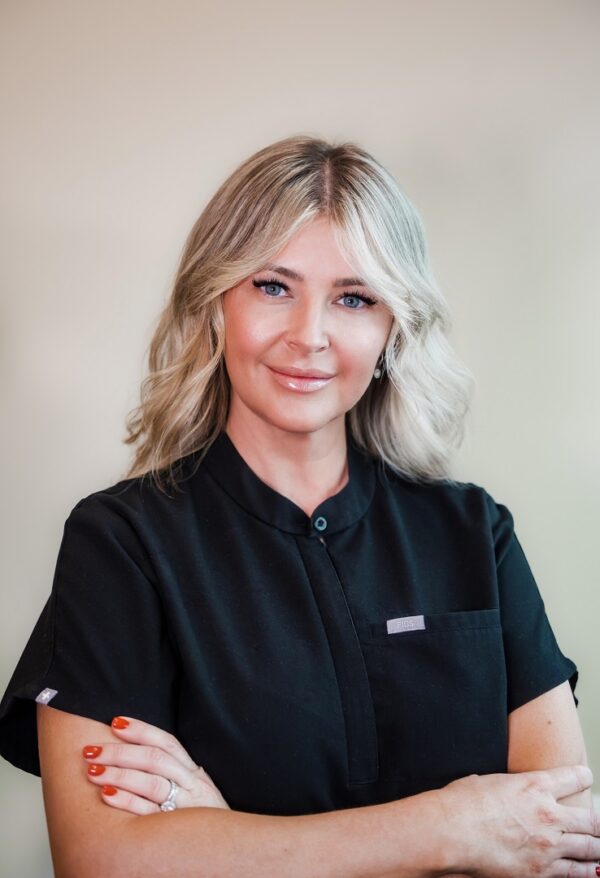
Anna Murrell is a medical esthetician who has spent fourteen years with Dr. Rudderman’s practice and more than two decades in skin care overall. She came to the United States from Crimea in 1998, having trained as a physician assistant and grown up in a family of doctors, and she found her way into esthetics after realizing that the medical knowledge she already carried gave her a natural head start. Anna built her following over seven or eight years in the Johns Creek and Alpharetta area before joining Dr. Rudderman’s team—where she started part-time, went full-time within her first month, and has felt at home ever since.
She handles anything to do with the skin: deeply customized facials, dermaplaning, medical chemical peels, microneedling with platelet-rich plasma, and CO2 laser resurfacing, all built on careful prep and, above all, meticulous aftercare. Her philosophy is that beautiful results are made in the healing—pre-treat the skin, respect the recovery, and stay consistent—and it shows in the patients who have followed her for more than twenty years. Outside the treatment room, she’s an avid hiker who gets to the Canadian Rockies at least twice a year, often with the husband she met at Orange Theory, who was her hiking partner first.
An Interview With Anna
Let the Skin Talk: A Conversation with Anna Murrell
Anna sat down to talk about the winding path that brought her from a medical family in Crimea to a treatment room in Alpharetta, why she cares more about prep and aftercare than almost anything, and how a search for a hiking partner turned into the last eight years of her life.
Let's start at the beginning. Where are you from, and how did you end up in esthetics?
You can probably hear the accent. I came to the United States in 1998, from Crimea. I’d trained as a physician assistant back home. My family members are all in medicine, so that was always where I was tracking. But when I got here, I found out my medical diploma didn’t transfer, and between the language barrier, having a young child, and starting over in a new country, going back through all of that medical training just wasn’t going to happen. Around that time, I was taking English courses and met a woman whose mother-in-law had been a doctor back home and had gone into esthetics here. I was very intrigued. Where I’m from, you had to be at least a nurse to practice esthetics; here you could start right out of high school. I figured I already knew a lot of the science, so it would come easily to me. I did an accelerated program, finished school in nine months, and started working. This was around 2000, when esthetics was nothing like it is now—no injectables, none of the fancy things everyone wants today. Just skin care and simple treatments. You really had to build a practice from the ground up.
Did you find a way to use your medical training?
The idea of being as close to medicine as possible never left me. So, I actually went into medical assisting first, working alongside a doctor and spending time in the OR, which gave me that medical experience I’d been after. Then I built up my esthetics practice, working in the Johns Creek and Alpharetta area. I built a real following, and some of those clients have been with me since 2000.
Ultimately, I planned to find a physician who worked in esthetics, so I could finally bring both halves of my background together. That search is what led me to Dr. Rudderman. During the interview process, I asked them as many questions as they asked of me. I asked how long they’d been in business, how long their employees had stayed—those indicators that tell you everything. I started part-time on purpose, because I need to feel the energy of a place first. Well, by the end of my first month I was full-time. That was fourteen years ago. I trust our core team 100 percent. It feels like home, and I know how rare that is.
Tell me what you do. What's in your wheelhouse?
Anything to do with the skin—that’s my thing. It starts with facials, but even a “simple” facial with me is completely customized. You come in, and I look at your skin and let it tell me what it needs that day. I touch it, I feel it, I read it, and I listen to what you’re telling me, too. That’s the foundation for everything else. From there we build up into the more advanced work … microneedling, medical chemical peels, and now our CO2 resurfacing laser. The technology in this field is incredible; lasers really came into their own about fifteen years ago, and it feels like there’s a new one every year. That’s why you never get bored. There are so many ways to combine treatments and tailor them to the person and the season.
What are you loving right now—where do people see the biggest "wow"?
Honestly, it can be the simplest thing: a dermaplane paired with a facial. Dermaplaning isn’t just about taking off the fuzz (though the fuzz is great), it’s all the dead skin that comes up with it. That combination is the foundation for everything else. Microneedling is also fantastic, and it’s a good year-round treatment, since the skin isn’t as sun-sensitive during recovery—and recovery is everything. My favorite version is microneedling with your own platelets: I draw your blood, spin it right there in the centrifuge, and we create platelet-rich plasma. A couple of years ago we started adding Daxxify, a neurotoxin that carries little peptides for the skin. Plasma, a touch of toxin, and peptides combined make the skin absolutely glow, and the downtime is only about twenty-four hours. Because it doesn’t rely on heat the way a laser does, the healing is gentle, which makes it a little safer than laser for a lot of people.
What about light-based treatments like BBL?
We do them, and I love what they can do, but it’s all about the right timing and the right patient, and that comes out of the consultation. Anything involving light or laser isn’t a summer treatment because of the sun. My longtime patients already know that—if you’ve been in the sun, we’re not doing lasers right now.
Everyone here at Dr. Rudderman’s office seem very conscitentious about the "before" and "after" of a treatment. What do you tell people?
This is where I put more emphasis than anywhere else. With my regular patients I don’t worry much—they’re already on their products, and the skin will tell me if they haven’t been using them, or if they’ve been in the sun. But if you’re new to me, that first visit is usually just a facial and nothing more. I have to prep your skin first. Skin that’s been pre-treated with medical-grade product responds better, heals better, and is safer to work on, for you and for me. So, I send you home with homework and see you again in about two to four weeks, once we’ve prepped and we both know the plan.
With brides, I map the whole thing out backwards from the wedding day. And then there’s the aftercare, which I care about more than almost anything. You can do a beautiful prep and a beautiful treatment, but if you don’t follow the post-procedure instructions, especially on the higher-downtime treatments like microneedling or lasers, you won’t get the result. It has to be the right product, something tested and soothing so there’s no reaction. It’s is especially important to protect the skin’s melanin during healing: when I create that controlled injury, the melanocytes are what repair it, and if you have more melanin or you’ve had too much sun, that pigment can go haywire and cause real trouble. When you heal correctly, that’s when you get the beautiful results.
Let's talk products. What brands do you love—and what do you wish would go away?
I love Revision Skincare and ZO Skin Health. And here’s the funny thing about peptides, which is the huge conversation right now—those lines have had peptides in them forever. We just never made a big deal of it. Now everyone’s suddenly discovering peptides, and I get to say, “You know you’ve already been using those, right?”
What drives me a little crazy is social media. Someone wakes up one morning, decides they’re an influencer, and starts telling everyone how to take care of their face. And the multi-level-marketing skincare, the “it’s all natural” pitch: if it were really working, you probably wouldn’t be sitting in my chair. What I want people to understand is that whatever you put on your face shows up in your results. It’s that simple.
Where do you see the science going?
I think we’re about to see an even bigger leap in products because of peptides. A lot of what’s coming is preventative. Of a thirty-year-old starts now, she’ll still age at fifty-five, but not the way my generation did. We lean hard toward prevention here. And there are more and more devices coming out with less downtime than we have today, which is a big advantage. Less redness, less recovery. People are going to love that.
How do you stay on top of all of this?
We have our laser conference once a year, and we take as many classes as we can through the associations. Last year we brought in a new skin-care line that comes with real education attached, including classes on hormonal changes and what happens to a woman’s skin through perimenopause and menopause. That’s the part I value: not just using the products, but understanding what a woman needs during that time. And a lot of companies come to us to introduce their technologies, so if something interests us, we’ll sit down and hear it out. A lot of the learning comes to us in-house, and the conferences and classes fill in the rest.
Tell me a little about life outside the office.
I have two grown sons. My oldest just moved to Colorado, all on his own, about a year ago—he’s in IT and he lives up in the mountains, which is honestly the life I dream about. When I grow up, I want to be him! My youngest is here in Georgia with me, so at least I’ve got one close by. I came to this country as an immigrant when my oldest was only two, so watching them build their own lives is really something. And I’m a hiker. I love my mountains. My nephew lives in Alberta, so we get to the Canadian Rockies at least twice a year.
I can credit hiking with my marriage, actually. I first met my husband at Orange Theory, about ten years ago, after my boys were out of the house. He asked what I did on weekends, and I told him I wanted to go hiking but couldn’t get any of my friends to come with me. He said, “I’ll go with you.” I said, “I don’t even know you!” But he became my hiking partner, every weekend. We would take turns picking the trail. And that was that. We were married in 2018. And he’s still my hiking partner. I really believe you and your person don’t have to share everything, but you need some of the same habits or a shared idea of how you want to spend your life. That matters more than a lot of the things people worry about.