

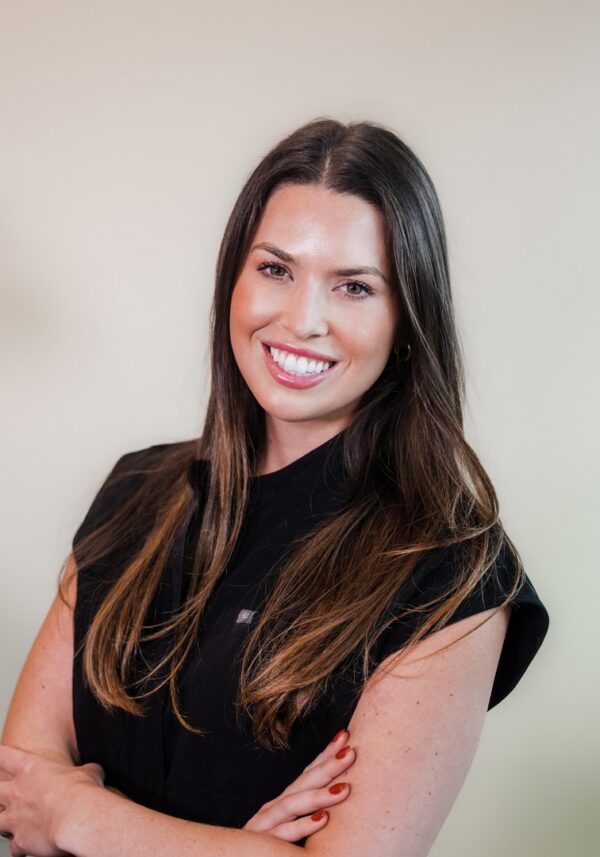
Brett Laughlin, NP, is a nurse practitioner and aesthetic injector at Dr. Rudderman’s Alpharetta practice and one of its most in-demand providers. Her path to aesthetics began in the operating room. At Penn Medicine in Philadelphia, home to the largest Mohs micrographic and reconstructive surgery clinic in the country, she assisted in hundreds of intricate facial reconstructions following treatment for aggressive skin cancers, building the deep anatomical foundation that still guides every treatment she performs today.
Brett went on to train under one of Philadelphia’s first nurse injectors before bringing seven years of injecting expertise to Atlanta. Today Brett is a national trainer for Revance, the maker of RHA fillers and Daxxify, a role that gives her early, hands-on experience with the next generation of injectables. She pairs a sophisticated understanding of facial anatomy with a natural talent for visualizing facial beauty and bringing that vision to life. It shows in her education-first approach, both in the treatment room, where she performs a full facial assessment and designs a custom “facial balancing” plan for every patient, and on social media, where her clear, jargon-free explanations of how injectables actually work have earned her a large and devoted following. Her promise to everyone who sits in her chair is simple: she’ll treat you like her sister.
An Interview With Brett
The Anatomy of a Great Injector
With a background in complex facial surgery, a national training role, and an Instagram following built on teaching, Brett Laughlin, NP, has become one of the most sought-after injectors at Dr. Rudderman Medical Spa. We sat down with her to talk about anatomy, artistry, and why she treats every patient like family.
You didn't start out as an injector. Where did your career begin?
I started as a nurse practitioner in Philadelphia, at Penn Medicine. I assisted in hundreds of very complex facial surgeries. From there, I trained under the first nurse injector in Philadelphia. She wanted to retire, so she hired me, and I mentored under her. I loved her. Then I moved to Atlanta, and I’ve been with Dr. Rudderman ever since. He’s wonderful and so supportive.
You're one of the most-booked providers here, and you've built a huge following on social media. What's your secret?
I just love to educate, and I really love anatomy. I do full facial assessments on everyone, and we deep-dive together: okay, we’re feeling this way, but why are we feeling that? I’m not trying to put Band-Aids over things; we’re trying to address concerns and understand how our faces work. That’s how I use neurotoxins to manipulate muscles. That’s how I lift an eyebrow, or make a jawline a little sharper without putting filler there. I love using filler to play with shadow and the anatomy of aging, or to address a deficit. If someone doesn’t have great chin projection, we can do a little filler instead of an implant. And I love biostimulators. When patients understand what I’m doing, everything changes. That’s the niche I found on Instagram: all my posts are educational. I try to make information about injectables easy to digest. I think anything is easy to understand when you explain it the right way.
New products, new toxins, new peptides keep emerging. How do you stay on top of it all?
I’m lucky. I have a really great relationship with my reps, so I usually have my hands on things before they even come out. I’m also a trainer for Revance, for RHA and Daxxify, so I get to explore the next generation of products. Beyond that, I educate myself constantly. I go to conferences, trainings, anatomy refreshers, cadaver courses. There’s something to learn every day. No one is ever really an expert, and if someone says they are, that’s exactly when you know they’re not. It’s always changing.
What are you loving right now? What's giving you the best results?
Honestly, it’s hard to name just one thing, because I make a completely custom treatment for every patient based on their needs and their wants. I might have a 23-year-old come in with a little under-eye hollowness and a recessed chin, so we’d do some chin filler and PRF gel. I might have a 50-year-old who’s lost a lot of volume on a GLP and wants it back, so we’d do more filler and pair it with skin tightening. And I might have someone who only needs Botox for a sharper jawline. The honest answer is facial balancing, everyone’s own custom plan. That’s where the best results come from, because everyone is different.
On the flip side, what are you seeing that you wish people would stop doing?
It’s like a pendulum. For a while everything swung natural, and now it’s swinging back toward overfilling. I’m seeing overdone injectables, especially on younger girls: filler they don’t really need. You have to be careful who you go to … find someone who’s going to treat your face with respect. I really try to do that with every patient. I always tell people: if you’re going to sit in my chair, I’m going to treat you like my sister. And I really mean that. I’m not going to overdo it on someone just because they ask for a ton of filler. I’ll say no. Sometimes patients get a little mad at me, but I don’t care. That’s how much I mean it.
You've said the future of esthetics is biostimulation. Tell us about that.
I’m obsessed with PRF gel right now. It’s PRP mixed with a little fibrin, which I then process into a gel. It’s also known as EZ Gel. There is absolutely a time and a place for filler. I’m obsessed with filler, I use it every day, I have plenty of it in my own face. But you reach a point where filler isn’t going to fix the problem. You need to strengthen skin and tissue that naturally weakens as we age. PRF gel is probably my favorite treatment for under eyes; it brightens and strengthens the skin there, and there’s really nothing else like it. Along the same lines, I love Sculptra for improving skin quality, and Daxxify, a newer neurotoxin. It’s the same kind of drug as Botox and Dysport, but Daxxify is preserved with a peptide that gives your skin a glow. So, if Botox isn’t giving you the results it used to, switching to Daxxify can work a little better, and you get that glow on top.
“Toxin” sounds a little scary. How does Botox work?
Botox is a neurotoxic protein; think of it as a medication. It goes to the nerve-muscle junction, the area where your nerves and muscles talk to each other, and it blocks acetylcholine receptors. Acetylcholine is what tells your muscles to move. So, the neurotoxin relaxes the muscle a little. The receptors aren’t fully blocked, so you often still have some movement, but it only works right where it’s injected. It’s one of the most-studied medications on the U.S. market. When you understand the background, it’s a lot less scary.
There is some confusion about filler, where it goes and how long it lasts …
It lasts a lot longer than most people think — I’d say closer to five years than one. I place filler into fat pads, which are almost encapsulated and held in place by facial ligaments, so it’s hard for it to move. Your face isn’t going to do a slip-and-slide and end up in your chin; it stays where I put it. Over time, your body does slowly break it down: we all have a natural enzyme called hyaluronidase, the same one that dissolves the hyaluronic acid in our own skin as we age, and filler is a synthetic version of that hyaluronic acid. So, it gets eaten up gradually, just not nearly as fast as people fear. Honestly, the fact it hangs around is a good thing. I have patients who’ve lost 100, 200 pounds on GLPs, and their faces have held up beautifully because of the filler we did in the past. That’s really cool.
Any last piece of advice?
One of the biggest barriers I see is unrealistic expectations. Sometimes I have to gently say: listen, this isn’t surgical. I’m not going to be able to give you a facelift with Botox. But can I make it a little bit better? Absolutely. At the end of the day, this work isn’t about chasing trends. It’s about understanding a face and treating it with respect.